 VIVAN Life Sciences Blog

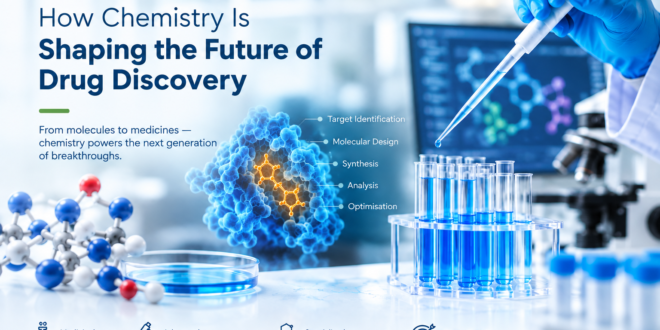
Every new medicine begins with a molecule. But turning that molecule into a potential medicine requires years of chemistry, research, testing, and discovery.
As pharmaceutical science continues to evolve, chemistry remains at the heart of drug discovery. Advances in molecular design, analytical technologies, computational science, and specialised chemical solutions are helping researchers explore new possibilities and develop medicines with greater precision.
From Molecules to Medicines
Drug discovery begins with identifying a biological target and finding molecules that may interact with it in a useful way. Researchers then study these molecules to understand their structure, activity, stability, and other properties.
Medicinal chemistry plays a key role in this process. Scientists modify and optimize molecular structures to improve characteristics such as potency, selectivity, stability, and safety.
This iterative process—design, synthesis, analyse, and optimize—can involve thousands of experiments before a promising candidate emerges.
The Growing Importance of Analytical Chemistry
Modern drug discovery depends heavily on accurate analytical data. Researchers need to know not only whether a compound has been created, but also whether it has the expected structure, purity, and characteristics.
Advanced analytical techniques such as LC-MS/MS, chromatography, and spectroscopy allow scientists to investigate compounds with increasing sensitivity and precision.
Analytical chemistry supports activities such as:
Compound identification
Purity and impurity analysis
Structural characterisation
Reaction monitoring
Method development
Stability studies
Bioanalytical research
Reliable analytical data helps researchers make informed decisions and optimise the drug discovery process.
The Role of Specialized Chemical Solutions
As drug discovery becomes more sophisticated, researchers increasingly require specialised chemical compounds and reference materials.
Stable isotope-labelled compounds, including deuterated compounds, can support a range of pharmaceutical and bioanalytical applications. They can be used as internal standards in quantitative LC-MS/MS methods and can assist researchers studying drug metabolism and pharmacokinetics.
Such specialised solutions can help scientists generate more reliable and interpretable analytical data throughout different stages of research.
Chemistry Meets Technology
The future of drug discovery is increasingly interdisciplinary.
Chemists are working alongside biologists, computational scientists, data specialists, and analytical experts to accelerate research and improve decision-making.
Computational tools and artificial intelligence can help researchers identify potential molecules and predict molecular properties, while advanced chemistry and analytical techniques provide the experimental foundation needed to evaluate these predictions.
The combination of human scientific expertise, advanced chemistry, analytical technologies, and computational approaches is opening new possibilities for pharmaceutical research.
Precision Is Becoming More Important
Drug discovery is moving towards greater precision.
Researchers are looking beyond simply finding compounds that work. They are increasingly interested in understanding why a compound works, how it behaves, what metabolites it produces, and how it interacts with biological systems.
This requires high-quality analytical data and carefully designed experiments.
From early discovery through preclinical and clinical research, chemistry and analytical science work together to provide deeper insights into drug candidates.
Building the Future Through Innovation
Innovation in drug discovery is not limited to discovering new molecules. It also includes developing better ways to synthesise, analyse, characterise, and evaluate them.
At VIVAN Life Sciences Pvt. Ltd., we believe that chemistry has an important role to play in this evolving scientific landscape. Our focus on specialty chemicals and research-oriented solutions reflects our commitment to supporting pharmaceutical and life sciences research.
We aim to contribute to a scientific ecosystem where quality, innovation, technical expertise, and customer understanding come together to create meaningful solutions.
Looking Ahead
The next generation of drug discovery will be shaped by the convergence of chemistry, biology, analytical science, data, and technology.
As researchers explore increasingly complex biological targets and molecular structures, the need for precise and reliable chemical and analytical solutions will continue to grow.
Chemistry will remain at the centre of this journey—not only as a discipline for creating molecules, but as a powerful tool for understanding, improving, and transforming them.
The future of medicine begins with discovery. And discovery begins with the science of chemistry.