VIVAN Life Sciences Blog

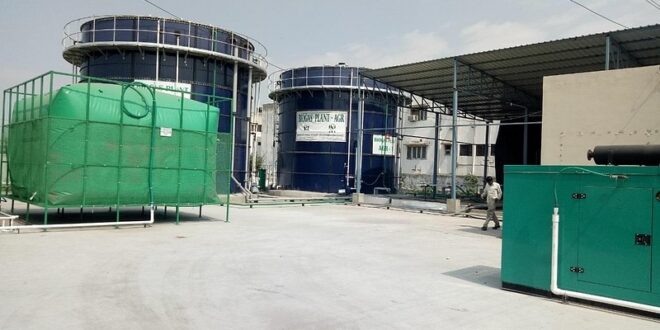
When you think of vegetable and fruit markets in India, you’re often met with messy visuals of vegetable shavings trampled on the floor, bustling crowds and bargaining vendors. The foul smell of leftover and damaged produce lying on the ground is not only unpleasant but also amounts to tonnes of waste generated at the end of the day.
But, at the Bowenpally fruit and vegetable market in Hyderabad, the vegetable waste generated is used to power street lights and shops. “Over the last six months, 10 tonnes of waste that is generated daily is then converted into 500 units of electricity. It is used to power 120 street lights, 170 shops, and a cold storage unit,” says Lokini Srinivas, Selection Grade Secretary, Bowenpally market. “Using the same waste, 30kg of biogas is produced through this process and is replacing LPG cooking gas in the canteen at the market,” he explains, adding that the market uses 800 to 900 units of electricity every day, and now 80% of the power supply is fulfilled with the biogas. On the days when Bowenpally market does not generate 10 tonnes of waste, neighboring vegetable markets and supermarkets pitch in.
Converting waste into a resource
The plant was set up under the guidance of CSIR-IICT (Council Of Scientific And Industrial Research–Indian Institute Of Chemical Technology) Chief Scientist Dr A Gangagni Rao. Because of his patented technology, unit could work at such a high rate capacity,”
The research using this technology has been conducted since 2012. Apart from producing electricity and biogas, the plant is also generating organic manure that can be used in farming. Earlier, a model using the same technology, but at a smaller capacity of 250 kgs, was installed at a poultry farm in Hyderabad where the farm waste was converted into energy. Its success prompted Dr Gangagni to engineer a system that could convert 10 tonnes of waste every day into biogas. The research at CSIR-IICT began in 2006 to find ways to produce biogas from vegetable, fruit and food waste. By 2011, They have developed a patented-technology which was tested on a small scale at various farms and kitchens across India. We have re-engineered the method to make it more efficient so that it could handle the higher capacity of waste and produce more energy,” says Dr Gangagni. The Department of Biotechnology picked up this project and provided a capital investment to set up the plant. The Department of Agriculture Marketing also supported the project and carried out the necessary civil work.
How does it work?
Every day, the waste is collected from across the Hyderabad market by a designated team hired on contract. This is brought to the plant located in the same premise and goes through a bio-methanation process. First, the waste is shredded, then it is soaked in a Feed Preparation Tank to be converted into a slurry. This undergoes an anaerobic bio-methanation process using a special culture (bacteria consortium). Finally, in separate tanks, the biogas is collected and directed to the kitchen for cooking. The biofuel is supplied into a 100% biogas generator which is used to power the water pumps, cold storage rooms, street and shop lights. Dr Gangagni says, “In the future, there are other markets where more biogas plants will be installed.”
Reference: The Better India